Foundation 02
Intelligence
The first pillar of the AI Ecosystem.
By Jim Costello · 7 min read
Artificial intelligence is the part of the AI Ecosystem most people see.
A chatbot answers a question. A model generates an image. Software writes code. An agent performs a task. A robot responds to the physical world.
These experiences can make AI appear to be primarily a software story.
But within our framework, Intelligence describes something broader: the capabilities that allow machines to interpret information, identify patterns, generate responses, reason through problems, pursue objectives and, increasingly, interact with both digital and physical environments.
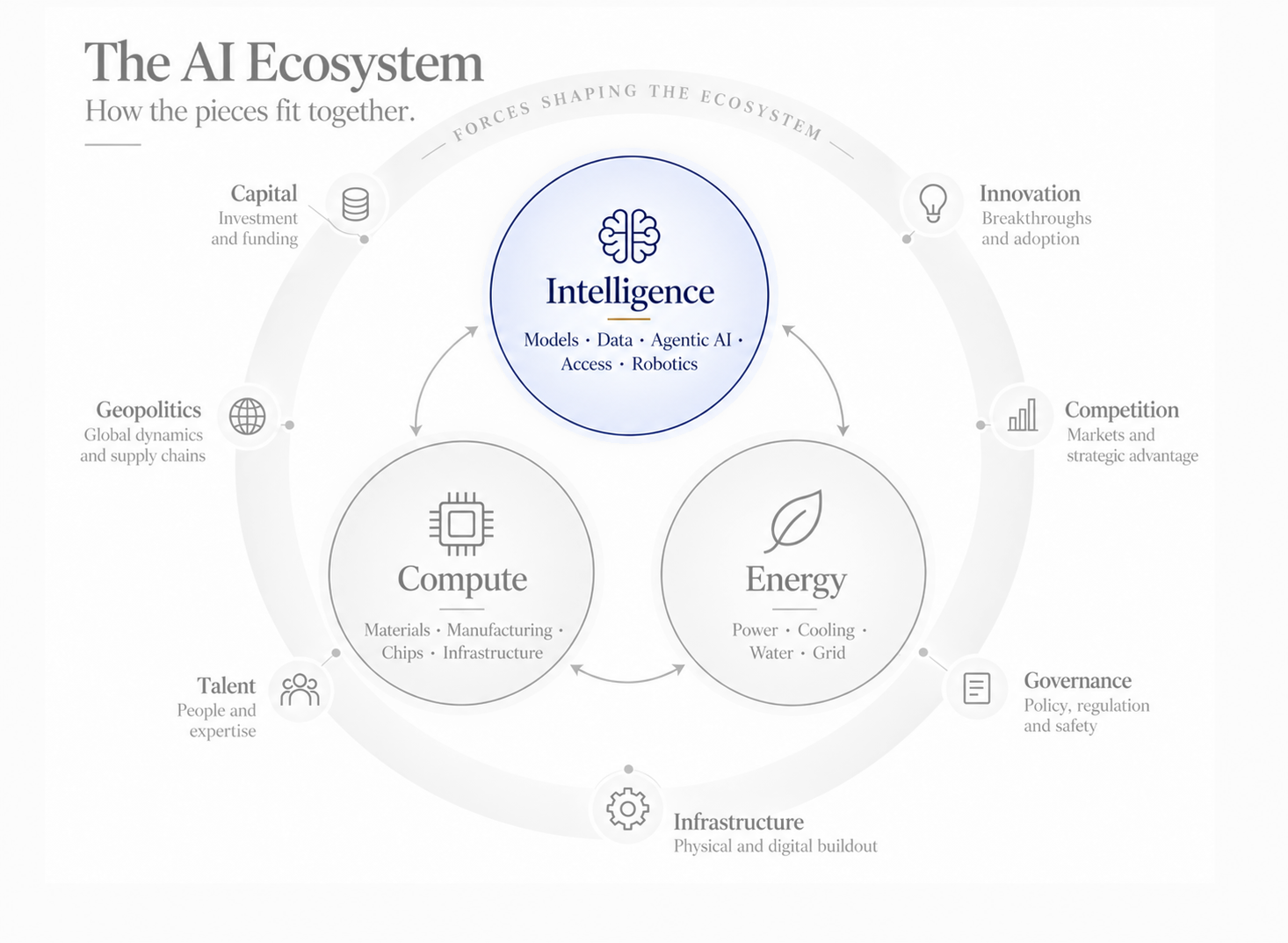
It is the first of the three pillars in the AI Ecosystem:
Intelligence. Compute. Energy.
None operates independently.
Intelligence requires Compute. Compute requires Energy. And the practical usefulness of Intelligence depends on data, access, tools, infrastructure and the ability to act.
This Foundation looks more closely at what we mean by Intelligence.
A short journey to modern AI
Artificial intelligence is not new.
Researchers have been exploring whether machines could imitate aspects of human intelligence since the middle of the twentieth century.
Progress did not occur in a straight line.
Periods of excitement were followed by periods of disappointment. Computing power was limited. Data was scarce. Early systems worked well on narrowly defined problems but struggled outside the conditions for which they had been designed.
Over time, several things changed.
More data became available.
Computing capacity increased.
Machine-learning techniques improved.
Neural networks became more capable.
And increasingly large models could be trained using enormous quantities of information and computation.
The emergence of modern large language models, or LLMs, brought these capabilities into everyday public view.
For many people, that was the moment artificial intelligence stopped being an abstract technological field and became something they could directly use.
Models
At the center of modern AI are models.
A model is a mathematical system trained to identify patterns in data and use those patterns to produce an output.
Different models perform different tasks.
They may interpret language, recognize images, generate video, predict structures, write software, analyze information or combine several forms of input and output.
Large language models are one important category.
An LLM is trained on very large amounts of text and related data to recognize patterns in language. That allows it to generate text, answer questions, summarize information, translate, write code and perform increasingly sophisticated forms of reasoning.
The important point for our framework is not the specific technical architecture.
It is that models provide capability.
What happens with that capability depends on the rest of the ecosystem around them.
Data
Models do not develop capability in isolation.
They depend on data.
Data can include text, images, video, audio, scientific information, software code, sensor information and many other forms of recorded knowledge or experience.
During training, models learn patterns from large datasets.
During use, they may also be given additional information or context relevant to a particular task.
Data therefore affects what models can learn, what they can understand and how useful their outputs may be.
But data also introduces questions that extend beyond Intelligence itself: ownership, privacy, quality, access, intellectual property and governance.
Those questions belong elsewhere in the ecosystem, but they influence what Intelligence can become.
Training and inference
Two terms are useful for understanding how modern AI works at a high level: training and inference.
Training is the process through which a model learns patterns from data.
It can require substantial computing resources, particularly for very large frontier models.
Inference is what happens when a trained model is used.
When we ask an AI system a question, generate an image or instruct an agent to perform a task, the model is performing inference.
Both require Compute.
But their demands can be different.
Training may involve an enormous concentration of computing resources over a period of time. Inference may involve millions or billions of individual interactions distributed across users and applications.
This distinction becomes important when we later examine Compute, data centers and Energy.
From response to action
One important change in artificial intelligence is the movement from systems that primarily respond toward systems that can increasingly act.
A conventional chatbot might answer a question.
An agentic system may be able to:
understand an objective → develop a plan → use tools → take actions → observe the result → adjust
This is what we mean by Agentic AI.
An agent does not necessarily possess greater underlying intelligence than another model. What changes is what the system is permitted and equipped to do.
That makes Access important.
A model connected only to a conversation window has limited ability to affect the outside world.
A model with permission to access software, databases, communications systems, financial tools, machinery or the internet has considerably greater practical capability.
The intelligence may be similar.
The ability to act is not.
Robotics
Robotics extends Intelligence from the digital world into the physical one.
A robot may combine:
- AI models
- cameras and sensors
- software
- mechanical systems
- navigation
- control systems
- physical actuators
This allows artificial intelligence to perceive and interact with physical environments.
The distinction is important.
Software can generate information.
Physical systems can move objects, manufacture products, operate equipment and interact directly with the world around us.
As intelligence, access and robotics become more closely connected, the boundary between digital AI and physical activity may become increasingly important.
Again, that connects Intelligence to other parts of the ecosystem: Compute, Energy, manufacturing, infrastructure, materials and governance.
AI, AGI and ASI
As AI capabilities improve, several terms frequently appear in public discussion.
They are useful, but they do not have universally agreed definitions.
Artificial Intelligence — AI
AI is the broadest term.
It describes machines or software capable of performing tasks associated with aspects of human intelligence, such as perception, language, prediction, reasoning, learning or decision-making.
Most systems we use today fall somewhere within this broad category.
Artificial General Intelligence — AGI
AGI generally refers to artificial intelligence capable of performing successfully across a very wide range of intellectual tasks rather than operating effectively only within narrow domains.
Exactly where that threshold lies is debated.
There is no single test that determines when an AI system becomes AGI.
Artificial Superintelligence — ASI
ASI generally refers to a hypothetical level of artificial intelligence that substantially exceeds human capability across most or all important cognitive domains.
It remains a concept rather than an established technological state.
That distinction matters.
We can define AGI and ASI without assuming either that they will occur or when they might occur.
Capability is not a single number
One difficulty in discussing AI is the temptation to place intelligence on a simple scale.
Reality is more complicated.
A system may be extremely capable at one task and weak at another.
It may outperform humans in certain forms of analysis while lacking common sense in other situations.
It may reason effectively but require access to external tools before it can act.
It may perform brilliantly under controlled conditions and fail when circumstances change.
That is why capability should be considered across several dimensions rather than treated as a single number.
The question is not simply:
How intelligent is the model?
It may also be:
- What can it understand?
- What can it reason about?
- What information can it access?
- What tools can it use?
- What actions can it take?
- How reliably can it perform them?
- How much human review remains necessary?
Improvement and feedback
AI capability continues to improve through several mechanisms.
Models can become larger or more efficient.
Training techniques can improve.
Data can improve.
Software can improve.
Tools and access can expand.
Hardware can become faster.
And AI itself can increasingly assist with activities such as coding, research, design and analysis.
This introduces the possibility of feedback loops.
Better intelligence may help improve software, chip design, scientific research or manufacturing processes. Improvements in those areas may then support better AI.
That does not automatically mean autonomous or unlimited self-improvement.
But it does illustrate why Intelligence cannot be understood in isolation.
The system improving Intelligence may increasingly include Intelligence itself.
Intelligence within the wider ecosystem
Within our framework, Intelligence includes:
Models · Data · Agentic AI · Access · Robotics
But each of these is itself part of a wider network of dependencies.
Models require Compute.
Robotics requires manufacturing and Energy.
Agents require software access and governance.
Data requires infrastructure and rules governing its use.
Talent drives research and deployment.
Capital funds development.
Competition influences speed.
Geopolitics affects access to technology.
Governance determines boundaries and accountability.
The pillar therefore connects continuously to the wider AI Ecosystem.
Why this matters
Much of the public discussion about AI focuses on whether a particular model is more capable than another.
That matters.
But model performance is only one part of the picture.
Practical impact depends on what intelligence can access, how reliably it operates, whether it can act and how effectively it connects with the physical and digital systems around it.
For our purposes, the objective is not to predict when AI becomes AGI, whether ASI will emerge or how quickly any particular capability will improve.
It is first to understand what Intelligence means within the ecosystem.
Because before we can judge where artificial intelligence may be going, we need a clearer understanding of what is actually developing.
Intelligence provides capability. The wider ecosystem determines how that capability can be built, accessed, deployed and used.
Continue the conversation
Ready Group welcomes thoughtful discussion around the ideas explored in Perspectives. For speaking engagements, panel discussions or private conversations on AI, leadership, strategy and organizational change, please get in touch.