Foundation 01
The AI Ecosystem
How the pieces fit together.
By Jim Costello · 6 min read
When people talk about artificial intelligence, the conversation often begins with the part they can see: a model, an application, a chatbot or an agent.
But AI does not exist in isolation.
Behind the visible technology sits a broader ecosystem of physical infrastructure, energy, data, software, capital, people, policy and competition. These elements interact with one another, depend on one another and change at different speeds.
That is why we prefer the word ecosystem.
A system can sound fixed, engineered and bounded. An ecosystem is more dynamic. It evolves. Some parts expand, others become constraints, new technologies change old assumptions, and the relative importance of different forces shifts over time.
The framework is stable. The variables are not.
For our own thinking, we simplify the AI ecosystem into three interdependent pillars: Intelligence. Compute. Energy. Around them sit a number of forces that influence how the ecosystem develops.
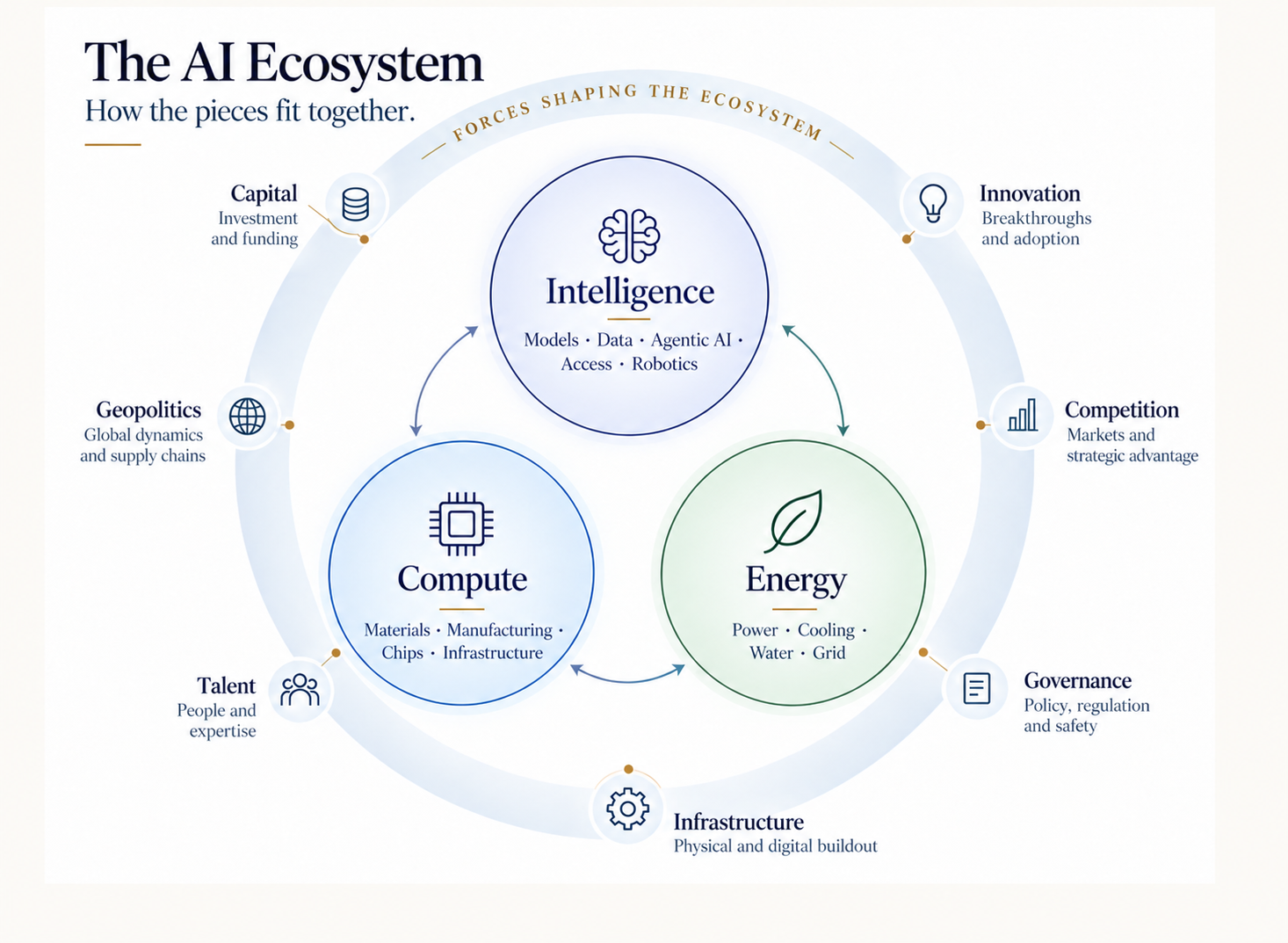
Intelligence
The first pillar is the one most people experience directly.
Models · Data · Agentic AI · Access · Robotics
Models
Models provide the underlying capability to analyze, reason, generate, plan and solve problems.
Data
Data provides information, context and material from which models can learn or draw relevant knowledge.
Agentic AI
Agentic AI refers to systems that can pursue an objective through a sequence of actions rather than simply produce a single response.
Access
Access determines what those systems can interact with - for example software tools, databases, communications platforms, the internet or other systems.
Robotics
Robotics extends digital intelligence into the physical world through machines, sensors and equipment.
These distinctions matter because intelligence alone does not determine practical impact. What a system can do also depends on its access, permissions and ability to act.
Compute
Intelligence depends on processing capacity. That is the role of compute.
Modern AI requires far more than the processor itself. Behind every AI workload sits a physical and industrial chain that includes raw materials, semiconductor manufacturing, chips, servers, networking and data-center infrastructure.
Materials · Manufacturing · Chips · Infrastructure
These elements determine how much processing capacity exists, where it exists, how efficiently it operates and how quickly it can expand.
Compute is therefore not simply a technical concept. It is also physical, industrial and increasingly strategic.
Energy
Compute, in turn, requires energy.
Processors, networking, storage and data centers all consume electricity and generate heat. Cooling becomes necessary. Water may be part of that cooling process, depending on the technology and facility. The wider electrical grid must also be capable of supporting the demand.
Power · Cooling · Water · Grid
This matters because AI can appear almost entirely digital to the user while depending on substantial physical infrastructure behind the screen.
Energy is therefore not separate from AI capability. It is one of the conditions that makes large-scale compute possible.
Interdependent by design
The three pillars do not operate independently.
Intelligence requires compute. Compute requires energy. Changes in one part of the ecosystem can affect the others.
A more efficient chip may reduce energy requirements. Additional power capacity may allow more compute to be deployed. Improved models may change how efficiently compute is used. Innovation in cooling, manufacturing or software can alter constraints elsewhere in the ecosystem.
The relationships are not perfectly linear. They are interconnected. That interdependence is another reason we find ecosystem a useful description.
Forces shaping the ecosystem
The three core pillars sit within a wider environment. For now, we group the major shaping forces into seven areas:
Capital: Investment and funding.
Innovation: Breakthroughs, improvements and new approaches.
Competition: Commercial and strategic pressure between companies, countries and platforms.
Governance: Policy, regulation, safety requirements and oversight.
Infrastructure: The physical and digital buildout required to support development and deployment.
Talent: People, expertise and organizational capability.
Geopolitics: National strategy, supply chains, trade restrictions and technological competition.
These forces do not carry equal weight at all times. Their influence can increase, diminish or interact with other parts of the ecosystem. For now, the important point is simply that they exist - and that they help shape how Intelligence, Compute and Energy develop.
A framework for future discussion
The purpose of this framework is not to decide which component matters most. It is to give us a common language and a consistent map.
| Topic | Where it sits in the framework |
|---|---|
| Semiconductors | Compute |
| Data centers, power generation or grid capacity | Energy and Infrastructure |
| AI agents or robotics | Intelligence |
| Export restrictions or national AI strategies | Geopolitics |
| Workforce changes | Talent, Intelligence and Competition |
Different topics illuminate different parts of the same ecosystem. That is how we intend to use the framework in future Foundations and Working Notes.
Why start here?
AI is developing quickly, and the discussion around it can become fragmented just as quickly.
Models. Chips. Data centers. Energy. Agents. Robotics. Regulation. Jobs. Investment. National competition.
Each can appear to be a separate subject. They are not. They are connected parts of a wider ecosystem.
Understanding those connections gives us a better starting point for exploring what is changing - before attempting to decide what those changes mean.
Understand the ecosystem. Observe what is changing. Separate fact from inference. Form a view only when the evidence supports one.

About the author
Jim Costello
Jim Costello is the founder of Ready Group. His career spans U.S. Army leadership, international banking and insurance, corporate leadership across Asia, and building and advising businesses. His current work increasingly explores how experienced human judgment can be combined with AI to improve strategy, decision-making and execution.
About JimContinue the conversation
Ready Group welcomes thoughtful discussion around the ideas explored in Perspectives. For speaking engagements, panel discussions or private conversations on AI, leadership, strategy and organizational change, please get in touch.