Foundation 03
Compute
The second pillar of the AI Ecosystem.
By Jim Costello · 7 min read
Artificial intelligence can feel weightless.
We type a question into a screen and receive an answer almost instantly.
But behind that interaction sits an enormous physical and industrial system.
Models must be trained.
Requests must be processed.
Data must be stored and moved.
Chips must be designed and manufactured.
Servers must be assembled.
Networks must connect them.
Buildings must house them.
That physical processing capability is what we broadly refer to as Compute.
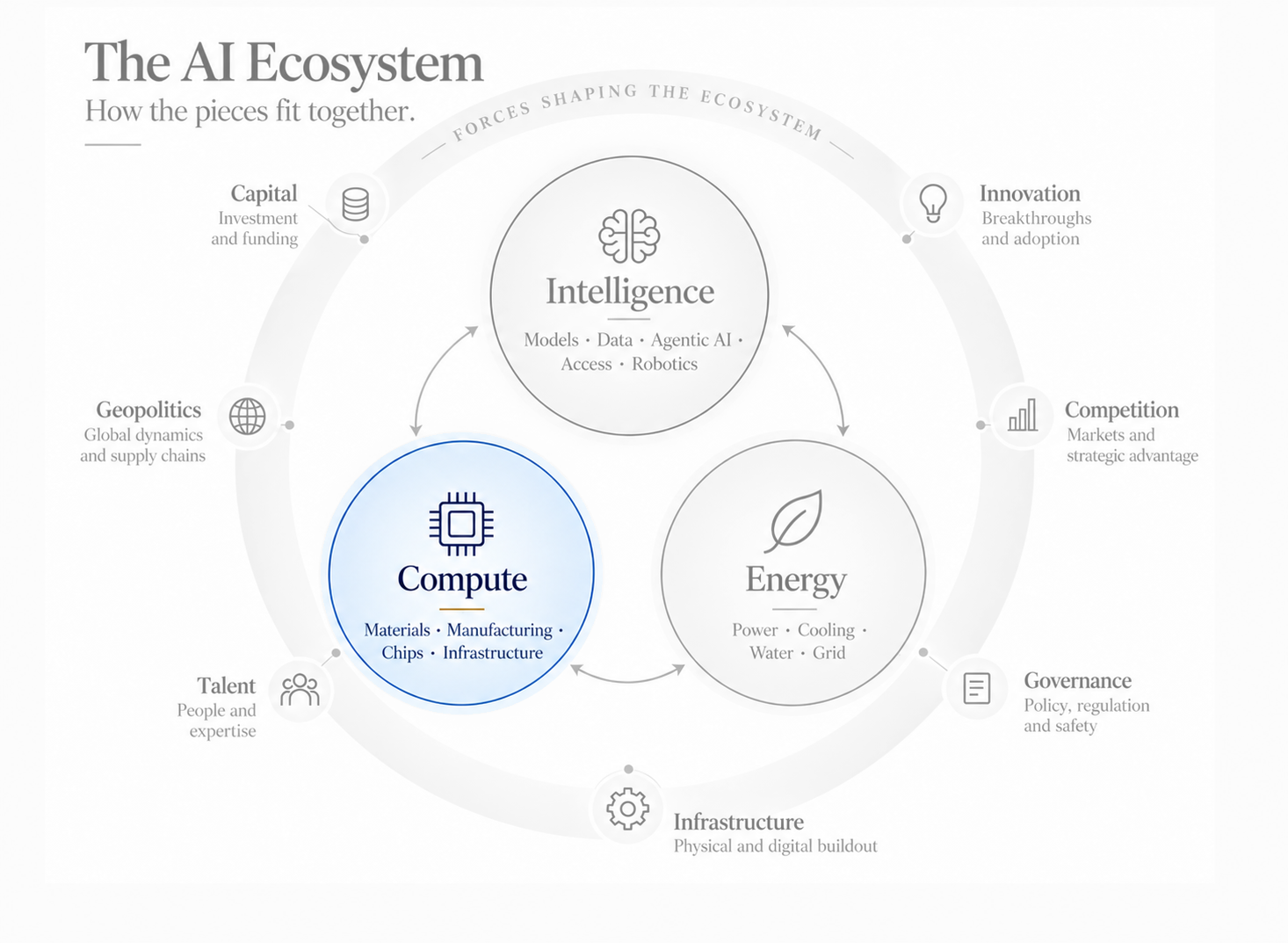
Compute is the second pillar of the AI Ecosystem:
Intelligence. Compute. Energy.
Intelligence depends on Compute.
And Compute, in turn, depends on Energy.
What is compute?
At its simplest, compute is the processing capacity used to perform calculations.
Every digital system requires it.
Artificial intelligence is unusual because modern AI can require very large amounts of computing capacity both to develop models and to operate them at scale.
When we use the word Compute in our framework, however, we mean more than processors.
We are describing the industrial ecosystem required to create and operate computing capacity:
Materials · Manufacturing · Chips · Servers · Networking · Data Centers
Each depends on the others.
Materials
The computing system begins with physical materials.
Semiconductors require highly refined silicon and many other specialized materials.
Manufacturing equipment itself depends on complex global supply chains.
Servers require metals, electronics, cooling systems and thousands of individual components.
Buildings require steel, concrete, cables and electrical equipment.
Even something that ultimately appears as software begins with physical inputs.
The digital world rests on a physical foundation.
Semiconductor manufacturing
Modern advanced chips are among the most complex products humans manufacture.
Their production involves multiple specialized stages, including:
- chip design
- semiconductor fabrication
- advanced manufacturing equipment
- materials and chemicals
- packaging
- testing
These activities are distributed across different companies and countries.
That creates an ecosystem within the Compute pillar itself.
A company may design an advanced processor without manufacturing it.
A manufacturer may fabricate chips using equipment produced elsewhere.
Packaging may occur in another location.
Critical materials may originate somewhere else again.
The final chip is therefore the product of an interconnected industrial system.
Chips
Chips perform the calculations required by AI systems.
Different processors are optimized for different workloads, but advanced AI increasingly relies on specialized accelerators capable of performing large numbers of calculations efficiently and in parallel.
The names and architectures will continue to change.
For our framework, the important point is simpler:
AI capability cannot scale without sufficient processing capacity.
This is why access to advanced chips has become commercially and strategically important.
Chips influence how quickly models can be trained, how efficiently they can operate and how widely AI services can be deployed.
Training and inference
Compute supports both training and inference.
Training is the process through which a model learns from data.
Training a large model can require substantial concentrations of computing capacity.
Inference occurs when the trained model is used.
Every question answered, image generated, calculation performed or action taken by an AI system requires some level of inference.
As AI adoption expands, this distinction matters.
A relatively small number of very large training runs may consume substantial Compute.
At the same time, widespread daily use of AI can create enormous aggregate inference demand.
The balance between those requirements will continue to evolve.
Servers and networking
A chip on its own does relatively little.
Large-scale AI requires many processors working together inside servers and larger computing systems.
Those systems must communicate quickly.
That makes networking critical.
Data must move between processors, servers, storage systems and users with very low delay and very high capacity.
The performance of an AI system therefore depends not only on the speed of individual chips but on how effectively the entire computing architecture works together.
Once again, the subsystem matters as much as the individual component.
Data centers
At sufficient scale, servers, networking, storage and supporting equipment are housed in data centers.
A data center is essentially a specialized facility designed to operate computing equipment reliably at scale.
It provides:
- physical space
- electrical distribution
- networking
- cooling
- security
- backup systems
- connections to telecommunications infrastructure
This is where the boundaries between our pillars begin to overlap.
A data center is part of Compute because it houses computing equipment.
But it is also closely connected to Energy because that equipment requires electricity and cooling.
And it belongs partly within Infrastructure because building and connecting data centers requires land, transmission, telecommunications, roads, permitting and supporting facilities.
That overlap is not a weakness in the framework.
It is the point.
The AI Ecosystem is interconnected.
Capacity is more than announced capacity
When discussing AI investment, it is tempting to count every announced data center, chip order or infrastructure project as available Compute.
But projects move through stages.
They may be:
announced → financed → permitted → under construction → connected → operational
Not every announced project becomes operating capacity.
Likewise, having a building does not necessarily mean having the chips, electricity, networking or customers required to use it fully.
Understanding Compute therefore requires distinguishing between planned capacity and usable capacity.
That distinction becomes particularly important when we examine AI investment in future Developments.
Rapid improvement and obsolescence
Compute has another important characteristic: technology changes quickly.
A building may remain useful for decades.
Electrical infrastructure may remain productive for even longer.
But some computing equipment can become economically less competitive much more quickly as newer generations offer better performance or efficiency.
This introduces the concept of obsolescence.
Obsolescence does not necessarily mean older equipment suddenly stops working.
It may mean that newer technology performs the same work faster, more efficiently or at lower cost.
That difference matters when large amounts of capital are invested in rapidly evolving technology.
Again, this is not a judgment about whether investment is excessive.
It is simply part of understanding the economics of the Compute ecosystem.
Compute has its own ecosystem
Compute therefore contains several interconnected layers:
materials → manufacturing → chips → servers → networking → data centers
Each is influenced by the wider forces shaping the AI Ecosystem.
Capital finances factories, chips and data centers.
Innovation improves performance and efficiency.
Competition pushes companies and countries to expand capacity.
Governance influences trade, permitting and deployment.
Infrastructure determines where facilities can be built.
Talent supports design, engineering and operation.
Geopolitics affects supply chains and access to advanced technologies.
The relative importance of each force changes depending on which part of Compute we are examining.
Friction within Compute
Compute also illustrates what we mean by friction.
More capital cannot instantly create more advanced chips.
A data center cannot operate merely because a company wants to build one.
Manufacturing capacity takes time.
Equipment may be scarce.
Land must be secured.
Facilities must be permitted.
Electrical connections must be available.
Supply chains must function.
Some friction comes from physical constraints.
Some comes from policy.
Some comes from engineering.
Some comes from economics.
The question is not automatically whether that friction is good or bad.
It is simply part of understanding how quickly an ecosystem can expand.
Why this matters
Compute turns artificial intelligence from an abstract capability into an industrial system.
Its components are physical.
They require materials, factories, specialized equipment, capital, buildings, networks and people.
They also change at different speeds.
A model may improve in months.
A new semiconductor fabrication facility may take years.
A data center may be built faster than the electrical infrastructure required to power it.
That difference in time scales can create constraints throughout the ecosystem.
For our purposes, the important starting point is straightforward:
Intelligence may be digital, but the capacity to create and deploy it is deeply physical.
Understanding Compute helps us see what exists behind the screen — and why chips, manufacturing, data centers, infrastructure and supply chains have become central to the development of artificial intelligence.
Continue the conversation
Ready Group welcomes thoughtful discussion around the ideas explored in Perspectives. For speaking engagements, panel discussions or private conversations on AI, leadership, strategy and organizational change, please get in touch.