Foundation 04
Energy
The third pillar of the AI Ecosystem.
By Jim Costello · 7 min read
Every artificial intelligence system ultimately depends on electricity.
Models may appear digital.
Compute may happen inside specialized processors.
But those processors must be powered.
They generate heat.
They must be cooled.
The facilities containing them must connect to electrical grids.
And the infrastructure supporting them must be capable of operating continuously and reliably.
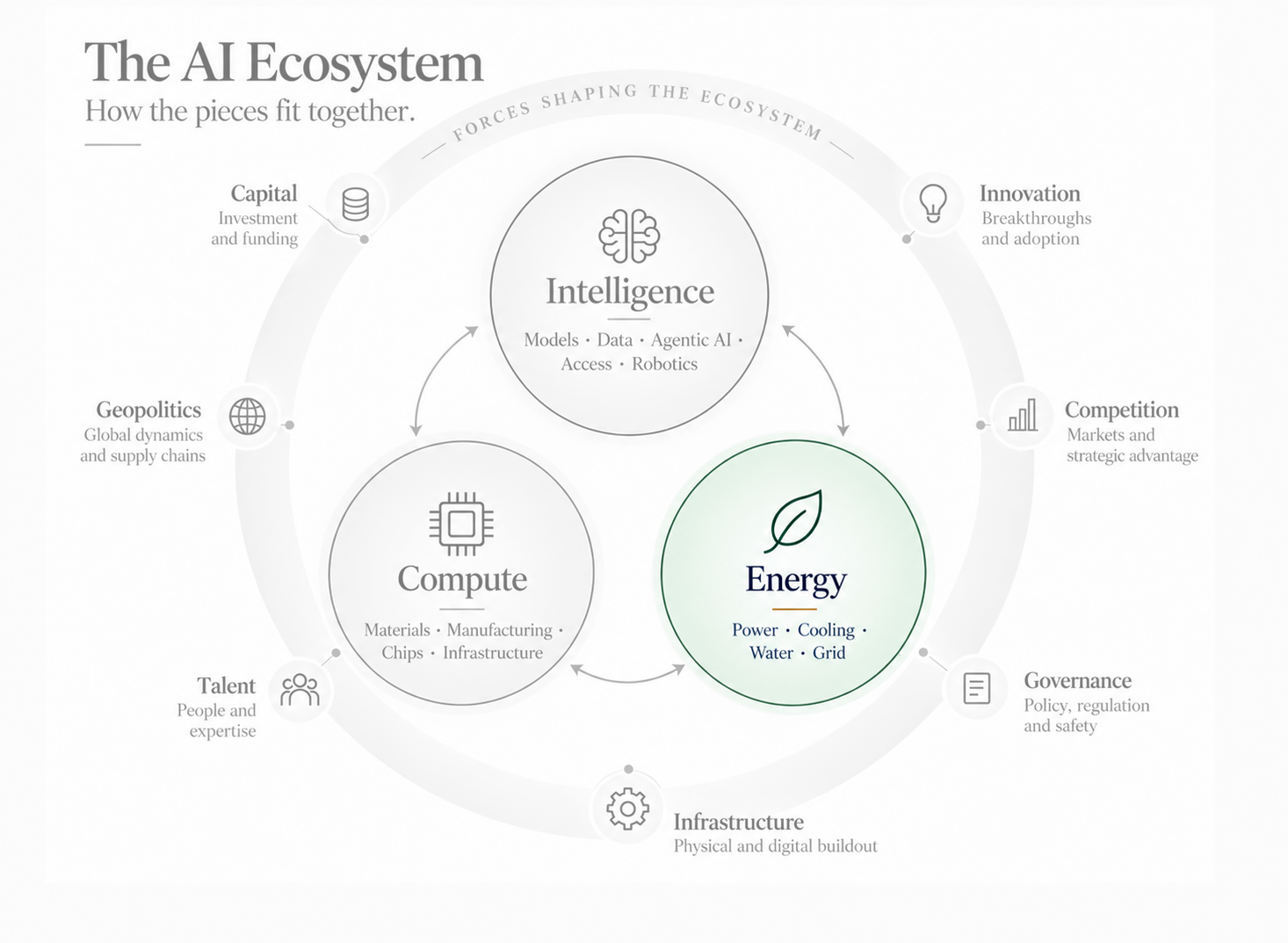
That makes Energy the third pillar of the AI Ecosystem:
Intelligence. Compute. Energy.
Intelligence requires Compute.
Compute requires Energy.
The relationship is straightforward in principle.
At scale, it becomes much more complicated.
Electricity
Computers require electricity.
A laptop requires relatively little.
A large data center containing thousands of high-performance processors requires substantially more.
As AI systems become more widely used, electricity is required both for developing models and for operating them.
That means Energy demand can grow for two different reasons:
greater capability — more powerful models and computing systems;
and
greater adoption — more people and organizations using AI more frequently.
The result is that electricity becomes part of the AI scaling question.
It is not simply a utility expense.
It can become a constraint on how much Compute can operate in a particular location.
Generation
Electricity must first be generated.
Different regions rely on different combinations of:
- natural gas
- coal
- nuclear power
- hydroelectric power
- wind
- solar
- other generation sources
Each source has different characteristics.
Some can operate continuously.
Some are variable.
Some can be expanded relatively quickly.
Others require substantial capital, construction time or regulatory approval.
From the perspective of the AI Ecosystem, the important question is initially not which source is preferable.
It is:
Is sufficient reliable power available where the Compute needs it?
That question connects Energy directly to geography, infrastructure, capital and policy.
The grid
Generating electricity is only one part of the system.
Power must also reach the place where it is required.
That requires electrical grids.
Grids include generation connections, high-voltage transmission systems, substations, distribution networks and the equipment required to balance supply and demand.
A region may theoretically generate enough electricity while still lacking the transmission capacity to deliver additional power to a particular location.
That makes grid capacity an important part of AI infrastructure.
Building a data center does not automatically mean the grid can support it.
And increasing generation does not automatically solve transmission constraints.
The Energy pillar is therefore itself an interconnected system.
Power density
AI infrastructure can also create concentrated demand.
A conventional commercial building uses electricity across lighting, heating, cooling and normal business activities.
A large AI computing facility can concentrate far greater electrical demand into a relatively small physical area.
This concept of power density matters.
The issue may not simply be total electricity consumption across an entire country.
It may be whether enough power can be delivered reliably to specific locations where large amounts of Compute are concentrated.
That can place pressure on local generation, substations, transmission and distribution systems.
Heat and cooling
Electricity flowing through computing equipment produces heat.
The more computing activity taking place, the greater the need to manage that heat.
Without adequate cooling, processors cannot operate reliably.
Cooling therefore becomes part of the Energy ecosystem.
Different facilities may use different technologies, including air cooling, liquid cooling or combinations of approaches.
As computing equipment becomes denser and more powerful, cooling systems may also need to evolve.
This creates another feedback relationship.
Better chips may perform more calculations.
More powerful systems may increase heat density.
Improved cooling may allow more Compute to operate in the same facility.
Changes in one part of the ecosystem affect others.
Water
Some cooling systems use water.
That means water can become another local consideration when data centers are developed.
The amount required varies significantly depending on facility design, climate, cooling technology and how water use is measured.
This is important because discussions about AI infrastructure can sometimes reduce water consumption to a single universal number.
There is no single number that describes every data center.
The appropriate question is more specific:
How does this facility obtain and use water, in this location, using this cooling design?
The same principle applies throughout the AI Ecosystem.
Scale matters.
Technology matters.
Location matters.
Reliability
AI infrastructure does not simply require electricity.
It requires reliable electricity.
Computing systems may operate continuously.
Interruptions can affect equipment, services and customers.
Data centers therefore frequently include backup systems and multiple layers of redundancy.
Reliability can influence where infrastructure is built and how much supporting investment is required.
This again illustrates why Energy cannot be separated neatly from Compute or Infrastructure.
The physical systems have to work together.
Scale
The amount of infrastructure now being proposed around artificial intelligence has drawn increasing attention to Energy.
That is understandable.
Modern AI can involve enormous concentrations of computing equipment, and many companies are planning substantial increases in capacity.
The resulting requirements for electricity, cooling, grid connections and supporting infrastructure may be large.
But the numbers should be approached carefully.
Announcements are not the same as completed projects.
Projected demand is not the same as actual demand.
Data centers differ substantially in size and purpose.
Technology also continues to improve.
Processors may become more efficient.
Models may require less Compute for particular tasks.
Cooling may improve.
Software may use hardware more effectively.
At the same time, greater efficiency can make AI cheaper and easier to use, potentially increasing overall demand.
For now, the important observation is not whether any particular forecast will prove correct.
It is that the scale, concentration and potential growth of AI-related electricity demand make Energy an increasingly important part of the ecosystem.
Energy has its own ecosystem
Just as Intelligence and Compute contain their own internal systems, so does Energy.
At a simplified level:
generation → transmission → grid → distribution → facility → cooling
Water, storage and backup systems may also play important roles.
Each layer has different economics, time horizons and constraints.
And each is affected by the broader forces shaping the AI Ecosystem.
Capital finances generation and infrastructure.
Innovation improves efficiency, storage and cooling.
Competition influences where new capacity is built.
Governance shapes permitting, environmental requirements and energy policy.
Infrastructure determines what can physically be connected.
Talent provides engineering and operational capability.
Geopolitics influences energy security, technology and supply chains.
The same framework applies.
The relative importance of the forces changes.
Different clocks
One of the most useful ways to understand the AI Ecosystem is to recognize that its components do not develop at the same speed.
Software can change rapidly.
Models can improve quickly.
New chips may arrive on comparatively short product cycles.
Energy infrastructure can operate on much longer timelines.
Power plants, transmission systems and grid upgrades may require years of planning, financing, permitting and construction.
This creates a potential mismatch between the speed of Intelligence and the speed of the physical systems supporting it.
That does not necessarily mean Energy will constrain AI.
Innovation, investment, efficiency and changes in deployment can alter the relationship.
But the difference in time scales is important to understand.
Friction within Energy
Energy also contains many forms of friction.
There may be limited generation.
Grid connections may take time.
Transmission may be constrained.
Permitting may be lengthy.
Local communities may have competing priorities.
Capital may be available while physical infrastructure is not.
Or infrastructure may exist where demand does not.
Again, friction is not automatically negative.
Safety standards, environmental review and grid reliability exist for reasons.
The relevant question is:
Where does friction exist, what purpose does it serve, and how does it affect the development of the wider ecosystem?
That question will become more important in future Developments.
Why this matters
Artificial intelligence is often discussed as though it exists entirely in software.
It does not.
Behind every model sits Compute.
Behind every unit of Compute sits Energy.
And behind that Energy sits a physical system of generation, transmission, grids, cooling, water, infrastructure and investment.
Understanding this changes how we see AI.
It becomes not simply a technological story, but an infrastructure story as well.
For our framework, that is the essential point:
AI may appear digital at the point of use, but its expansion depends on physical systems capable of supplying energy at the scale, location and reliability that Compute requires.
Continue the conversation
Ready Group welcomes thoughtful discussion around the ideas explored in Perspectives. For speaking engagements, panel discussions or private conversations on AI, leadership, strategy and organizational change, please get in touch.