Foundation 05
Forces Shaping the AI Ecosystem
The environment around Intelligence, Compute and Energy.
By Jim Costello · 8 min read
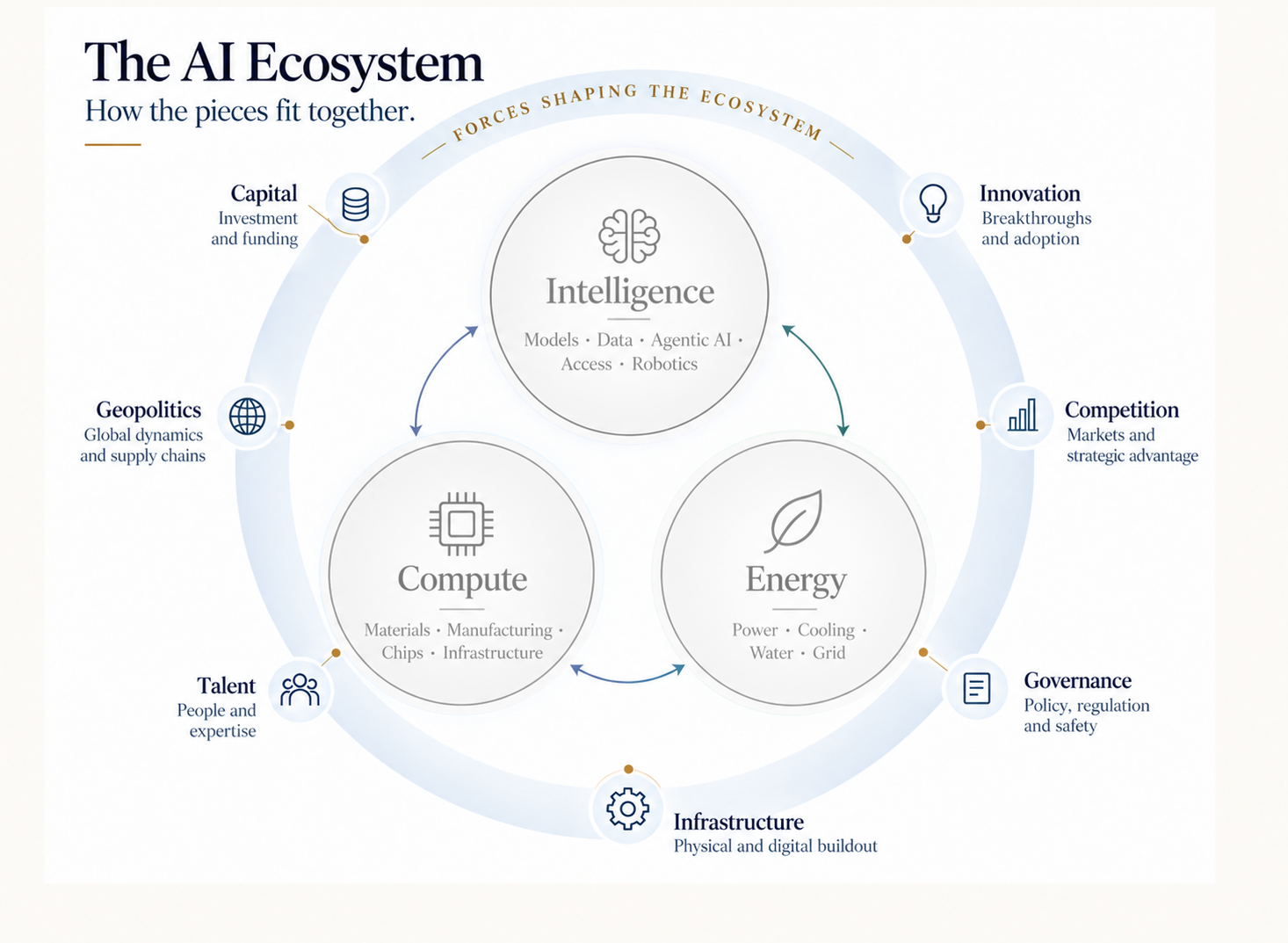
The three pillars of the AI Ecosystem — Intelligence, Compute and Energy — describe much of what artificial intelligence requires to develop and operate.
But none of those pillars develops in isolation.
Models require investment.
Chips depend on manufacturing capacity and supply chains.
Data centers require land, infrastructure and power.
Research depends on talent.
Companies respond to competition.
Governments establish rules.
Countries make strategic decisions about technology, trade and national capability.
These influences sit around the three pillars in our AI Ecosystem framework.
For now, we group them into seven broad forces:
Capital · Innovation · Competition · Governance · Infrastructure · Talent · Geopolitics
They are not separate from the ecosystem.
They help shape it.
And their relative importance changes depending on which part of the ecosystem we are examining and when we are examining it.
The framework is stable. The variables are not.
Capital
Artificial intelligence requires enormous amounts of investment.
Capital finances research, companies, semiconductor facilities, chips, data centers, energy infrastructure, networks and the people required to build and operate them.
It can come from many sources:
- company cash flow
- public equity markets
- private investors
- venture capital
- debt
- governments
- sovereign investment
- strategic partnerships
Capital determines, in part, which ideas can be developed and how quickly infrastructure can be built.
But access to capital is not the same everywhere.
Some companies can invest billions from existing businesses.
Start-ups may depend on external investors.
Governments may directly fund strategic technologies.
Other projects may rely heavily on debt.
Capital therefore influences not only how much gets built, but also who can participate and what return may eventually be required.
Those questions become important when we examine AI investment more closely in future Developments.
For this Foundation, the simpler point is:
Capability requires resources, and capital helps determine where those resources can be deployed.
Innovation
Innovation changes what is possible.
It may come from a new model architecture.
A more efficient chip.
A different cooling system.
A better battery.
New manufacturing techniques.
Improved software.
A breakthrough in robotics.
Or simply a better way of combining technologies that already exist.
Innovation matters because the constraints inside the AI Ecosystem are not fixed.
A shortage that appears critical today may become less important if technology changes.
A model requiring enormous amounts of Compute may later perform the same task more efficiently.
A new cooling system may allow denser computing infrastructure.
A manufacturing improvement may increase chip production.
Innovation can therefore change relationships throughout the ecosystem.
It is one reason why forecasting AI development is difficult.
The system does not simply grow.
It changes while it grows.
Competition
Companies compete.
Countries compete.
Platforms compete.
Researchers compete.
Capital competes for opportunities.
Competition can accelerate development because participants have incentives to improve capability, lower costs, attract talent and move faster.
A company may invest because a competitor is investing.
A government may support domestic technology because another country is advancing.
A technology platform may release a product sooner because another company has already entered the market.
Competition can therefore increase the speed of the ecosystem.
But competition can also influence behavior.
Participants may accept greater costs.
They may build capacity before demand is fully understood.
They may prioritize speed over efficiency.
Or they may pursue technologies because the perceived cost of falling behind appears greater than the cost of investing.
That does not make competition good or bad.
It simply makes it an important force.
The direction of investment can be shaped not only by expected opportunity, but by the perceived consequences of not participating.
Governance
Governance is often used as another word for regulation.
We use it more broadly.
Governance includes the rules, incentives, oversight and accountability that influence how decisions are made.
That can include:
- laws and regulation
- government policy
- corporate boards
- internal controls
- safety testing
- approval processes
- industry standards
- disclosure
- investor discipline
- lending standards
- institutional oversight
- enforcement
- accountability
Governance can exist inside companies, across industries and through governments.
Its role is not necessarily to stop development.
Governance may establish boundaries, assign responsibility, protect participants, manage risk or create the conditions for trust.
Different parts of the ecosystem may require different forms of governance.
A model may raise questions about safety and data.
A chip supply chain may raise trade and national-security questions.
A data center may require planning and environmental approvals.
An autonomous system may raise questions about responsibility for decisions.
The underlying governance question is often:
Who sets the boundaries, who monitors them, and who is accountable for what happens?
We will explore that question more deeply in future Developments.
Infrastructure
AI depends on infrastructure.
Some of it is obvious:
- data centers
- electricity grids
- telecommunications networks
- semiconductor facilities
- roads
- buildings
- fiber connections
Other infrastructure is less visible.
Research institutions.
Cloud platforms.
Digital networks.
Supply chains.
Industrial clusters.
Ports and logistics.
Infrastructure provides the systems through which the three pillars can operate at scale.
It is closely connected to Compute and Energy, which is why some components appear in more than one part of our framework.
A data center, for example, contains Compute.
But the ability to build and operate that data center depends on wider Infrastructure: land, telecommunications, electricity connections, transport and supporting services.
This overlap is intentional.
The ecosystem is interconnected.
Talent
Technology is built by people.
Scientists develop models.
Engineers design chips.
Technicians operate facilities.
Electricians connect infrastructure.
Researchers discover new approaches.
Managers allocate resources.
Governments develop policy.
Entrepreneurs create companies.
Talent therefore sits across every part of the ecosystem.
But talent is not simply the number of people available.
It includes:
- expertise
- experience
- education
- organizational capability
- leadership
- research institutions
- mobility
- the ability to attract and retain skilled people
Different parts of the ecosystem require different forms of talent.
Frontier AI research may require highly specialized expertise.
A semiconductor facility requires another set of skills.
Energy infrastructure requires another.
Large-scale deployment requires management and operational capability.
A country or company may possess capital but lack the people needed to deploy it effectively.
Talent therefore acts both as an enabler and, sometimes, as a constraint.
Geopolitics
Artificial intelligence is increasingly connected to national strategy.
Countries care about economic competitiveness.
They care about advanced technology.
They care about supply chains.
They care about communications, infrastructure, defense and national security.
As a result, decisions about AI increasingly interact with geopolitics.
That can include:
- trade restrictions
- export controls
- industrial policy
- domestic manufacturing
- energy security
- access to materials
- technology alliances
- national AI strategies
- strategic investment
A chip designed in one country may depend on manufacturing equipment from another, fabrication somewhere else and materials sourced globally.
An AI company may operate internationally while relying on infrastructure located in several jurisdictions.
A data center may depend on both local energy policy and global technology supply chains.
Geopolitics can therefore affect what technology is available, where it can be built and who can access it.
Again, the purpose here is not to determine which national strategy is better.
It is to recognize that AI development increasingly sits within a wider strategic environment.
The forces interact
These seven forces do not act independently.
Capital may fund Innovation.
Competition may attract Capital.
Geopolitics may change where Infrastructure is built.
Governance may affect access to Capital.
Talent may move toward places with stronger research ecosystems.
Innovation may reduce an Energy constraint.
Infrastructure may attract new companies and Talent.
One force can strengthen, weaken or redirect another.
This means that understanding the AI Ecosystem requires more than identifying individual components.
We also need to understand the relationships between them.
Their importance changes
Not every force matters equally everywhere.
Consider advanced semiconductors.
Geopolitics, Innovation, Talent, Capital and manufacturing Infrastructure may all be particularly important.
Now consider a new data center.
Capital still matters.
But Energy, grid Infrastructure, land, permitting and local Governance may become much more important.
For frontier model development, Talent, Compute, Capital and Competition may dominate.
For robotics, manufacturing capability and physical Infrastructure may become increasingly important.
The same framework remains useful.
The weighting changes.
The same forces operate across the ecosystem, but their relative importance changes by subsystem, location and time.
Friction
Another way to understand these interactions is through the idea of friction.
Friction is anything that slows, constrains, reviews or interrupts movement through the ecosystem.
It might be:
- lack of capital
- limited chip supply
- grid connection delays
- regulation
- human review
- permitting
- talent shortages
- supply-chain constraints
- organizational decision-making
Friction is not automatically bad.
Some friction exists because something is physically difficult.
Some protects safety.
Some creates accountability.
Some simply reflects inefficient processes.
And some may create a competitive disadvantage.
Different ecosystems may experience friction in different places.
One country may make infrastructure easier to build but capital harder to access.
Another may provide abundant private capital but have slower permitting.
A company may move quickly because its technologies and businesses are closely integrated.
Another may depend on many outside partners.
The useful question is not simply:
How much friction exists?
It is:
Where does friction exist, what purpose does it serve, and how does it affect the development of the ecosystem?
That question will become increasingly useful as we examine specific Developments.
Ecosystems within ecosystems
The shaping forces also help explain why we describe AI as an ecosystem rather than a simple technology stack.
Each pillar contains smaller ecosystems.
Compute contains materials, manufacturing, chips, servers, networking and data centers.
Energy contains generation, transmission, grids, cooling and water.
Intelligence contains models, data, agents, access and robotics.
Each subsystem experiences Capital, Innovation, Competition, Governance, Infrastructure, Talent and Geopolitics differently.
And each can interact with the others.
The result is not one simple chain.
It is a network of connected systems developing at different speeds under different pressures.
Why this matters
When we hear about a new AI model, chip, data center, investment or government policy, it can be tempting to examine that development by itself.
Our framework encourages us to ask a broader set of questions.
Where does it sit in the ecosystem?
What does it depend on?
What else might it affect?
Which forces are shaping it?
Where are the constraints?
Where is the friction?
And which variables may be changing?
Those questions do not give us an automatic answer.
They give us a better starting point.
That is what the AI Ecosystem framework is intended to provide.
Intelligence, Compute and Energy describe the core system. Capital, Innovation, Competition, Governance, Infrastructure, Talent and Geopolitics help explain how that system develops.
Continue the conversation
Ready Group welcomes thoughtful discussion around the ideas explored in Perspectives. For speaking engagements, panel discussions or private conversations on AI, leadership, strategy and organizational change, please get in touch.