Development 02
Could an AI Bubble Become a Financial Crisis?
Scale, concentration, governance and the question of who ultimately owns the risk.
By Jim Costello · 6–7 min read
Much of the discussion about AI risk looks toward the future.
What happens if artificial intelligence reaches AGI or ASI?
What happens to employment?
Can increasingly autonomous systems remain aligned with human objectives?
Could sufficiently capable AI eventually create risks humans cannot control?
Those are important questions.
But there may be another category of risk worth considering — one that does not require AI to reach AGI, ASI or anything close to them.
What happens if we miscalculate the investment cycle on the way there?
Artificial intelligence is already attracting extraordinary amounts of capital.
A relatively small number of technology companies account for a significant share of major public markets.
Infrastructure investment is expanding across chips, data centers, electricity, grids and financing.
Companies and governments increasingly view AI leadership as strategically important.
None of this means a financial crisis is coming.
But it raises a different set of questions:
How much is being invested?
How concentrated is the exposure?
How is the investment financed?
Who is taking the risk?
Who ultimately holds it?
And who is accountable if private investment losses become a broader public problem?
The comparison with 2008 is not a prediction that history will repeat.
It is a way to identify the conditions that turned an investment problem into a systemic one — and ask which of those conditions are present, absent or different today.
A bubble and a financial crisis are not the same thing
Markets fall.
Companies fail.
Investors lose money.
Most corrections do not become systemic crises.
The 2008 financial crisis was different because losses did not remain where they began.
Leverage amplified them.
Risk was distributed across institutions.
Complexity obscured exposure.
Confidence collapsed.
Governments and central banks ultimately had to intervene.
The broader lesson is:
Financial systems become more fragile when leverage, concentration and complexity rise faster than understanding.
Investment can move faster than understanding
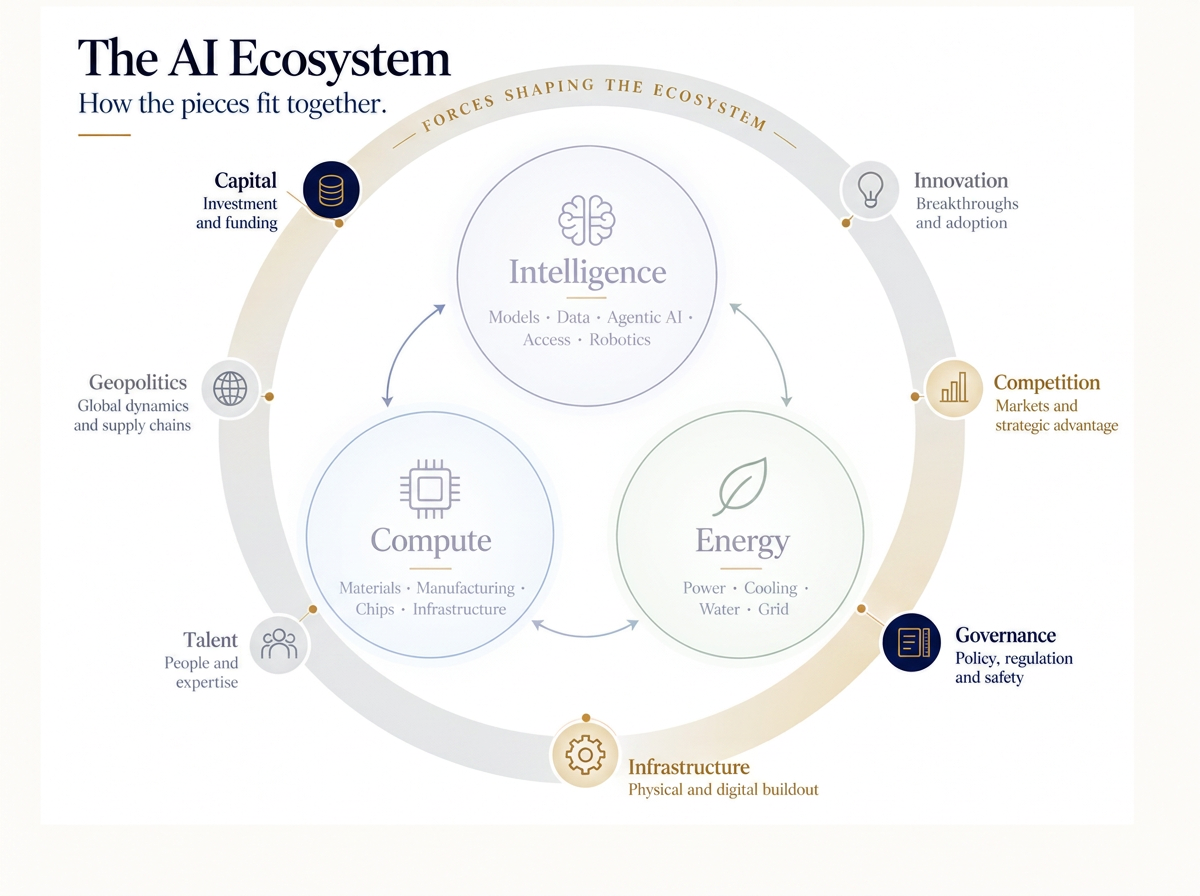
In our previous article, Development 01 — Are We in an AI Bubble?, we argued that AI is not one market but an interconnected ecosystem of technologies, infrastructure, businesses and capital.
Investment can sometimes become organized around the broad narrative — “AI” — before participants fully understand which parts of the ecosystem are creating value, which are capturing it, and which are carrying the risk.
That matters more when leverage and financial complexity increase.
A market can absorb uncertainty more easily than a financial system can absorb misunderstood leverage.
The important question is not whether every investor understands the technical workings of AI — they do not need to.
The question is whether enough participants understand the economic assumptions underneath the investments they own or finance.
Scale
AI investment extends across public markets, private companies, semiconductors, data centers, power infrastructure, grids, private credit and government-supported projects.
The absolute amount of capital involved is enormous.
That does not make the investment dangerous.
But scale matters.
The larger the investment cycle, the greater the potential economic impact if capital is badly allocated.
At what point does AI-related capital expenditure become large enough to matter beyond the companies making the investments?
Concentration
A relatively small number of large technology companies account for an unusually important share of major equity markets.
That means millions of people may be exposed indirectly through:
- 401(k)s
- IRAs
- pension funds
- index funds
- mutual funds
- insurance portfolios
- institutional and sovereign funds
An investor may own hundreds of companies and still carry meaningful concentration risk if a small number dominate the index.
So:
What counts as AI-related financial exposure when broad-market portfolios are heavily influenced by the largest technology companies?
A major repricing would not automatically cause a financial crisis.
But it could affect household wealth, retirement assets and market confidence far beyond investors who consciously chose to invest in AI.
The size of the prize
AI may involve more than financial returns.
For companies, the stakes may include:
- market leadership
- corporate survival
- platform control
- technological advantage
For governments:
- national competitiveness
- defense
- infrastructure
- technological sovereignty
- geopolitical influence
That changes behavior.
AI may combine financial incentives with strategic, technological and geopolitical ones.
The larger the perceived prize, the stronger the incentive to continue investing even when conventional returns become less certain.
Leverage and transmission
Leverage is one of the main differences between an investment loss and a financial crisis.
Equity can fall sharply without threatening the financial system.
Debt is different.
Borrowers must continue servicing obligations even when an asset loses value or produces less cash flow than expected.
So the financing structure matters.
Is AI investment funded through:
- retained earnings
- equity
- corporate debt
- project finance
- private credit
- bank lending
- government guarantees
The same project can carry very different systemic risk depending on how it is financed.
And risk can migrate.
A technology company invests.
An infrastructure developer borrows.
A private-credit fund finances the project.
A pension fund allocates to that fund.
An insurer holds related debt.
A bank provides additional financing.
The connections can become difficult to see.
This is not mortgage securitization.
But the underlying question is similar:
Do we understand who ultimately owns the risk?
Governance and accountability
This is also a governance question.
If AI investment succeeds, much of the upside may accrue privately.
If losses become systemic, the public sector may eventually be expected to stabilize parts of the system.
That raises a basic question:
If the upside is private but the downside becomes public, are ownership, risk and accountability properly aligned?
The issue is not punishment.
It is responsibility.
Who makes the decision? Who receives the upside? Who carries the downside? And who is accountable if the risk becomes systemic?
Those questions should ideally be answered before a crisis, not during one.
Government capacity
Governments and central banks still have powerful crisis-management tools.
They can provide liquidity, adjust rates, purchase assets, offer guarantees and support financial institutions.
But the starting position may be less comfortable in many countries.
Government debt is higher.
Fiscal deficits are large.
Aging populations create growing pension and healthcare obligations.
Defense and infrastructure spending compete for resources.
And inflation can make monetary intervention harder.
So the question is not whether governments still have tools.
They do.
It is:
How much room do they have to use them if a future crisis arrives alongside already elevated debt and fiscal pressure?
What is different from 2008?
There are important reasons not to overstate the comparison.
Many of the largest technology companies are highly profitable.
Several have substantial cash resources.
Much AI investment is funded from strong corporate balance sheets rather than fragile household borrowing.
Banks are generally better capitalized than before 2008.
And a decline in technology valuations does not automatically impair the banking system.
A large market correction could destroy substantial wealth without becoming a financial crisis.
That distinction matters.
What would make it systemic?
The key issue is transmission.
A technology-heavy market could fall sharply.
Retirement accounts could decline.
Projects could be cancelled.
Private investors could suffer losses.
Companies could fail.
All of that would matter.
But a financial crisis requires something more:
Losses must transmit through leverage, credit markets, financial institutions or other interconnected systems in ways that threaten their ability to function.
That is what we should watch.
Scale. Concentration. Governance. Risk ownership.
Four questions seem particularly useful:
Scale — how large is the investment cycle?
Concentration — how much market and portfolio exposure sits with a relatively small number of companies?
Governance — who is challenging assumptions, setting boundaries and monitoring risk?
Risk ownership — who makes the decisions, who receives the upside and who ultimately carries the downside?
Behind those questions sit the mechanisms that can spread losses:
leverage · complexity · interconnection
None of this proves that a crisis is coming.
It gives us a framework for understanding what would have to change before a correction became something more.
Our current working view
We do not currently see a reason to assume an AI correction would become another 2008.
But that does not make the comparison irrelevant.
The useful question is not:
Will AI cause a financial crisis?
It is:
What conditions would allow an AI investment correction to become systemic?
We would watch:
- leverage
- weaker underwriting
- private-credit exposure
- complex financing
- concentration of risk
- dependence on rising valuations
- optimistic utilization assumptions
- deteriorating transparency
- government guarantees
- growing financial-institution exposure
If those remain limited, an AI correction may remain primarily an investment-market event.
If several rise together, the question becomes more consequential.
And one question becomes central:
Who ultimately owns the risk?
The lesson from housing is not that AI will cause another 2008. It is that financial systems become more fragile when leverage, concentration and complexity rise faster than understanding.
Continue the conversation
Ready Group welcomes thoughtful discussion around the ideas explored in Perspectives. For speaking engagements, panel discussions or private conversations on AI, leadership, strategy and organizational change, please get in touch.