Development 01
Are We in an AI Bubble?
What should we actually be measuring?
By Jim Costello · 5–6 min read
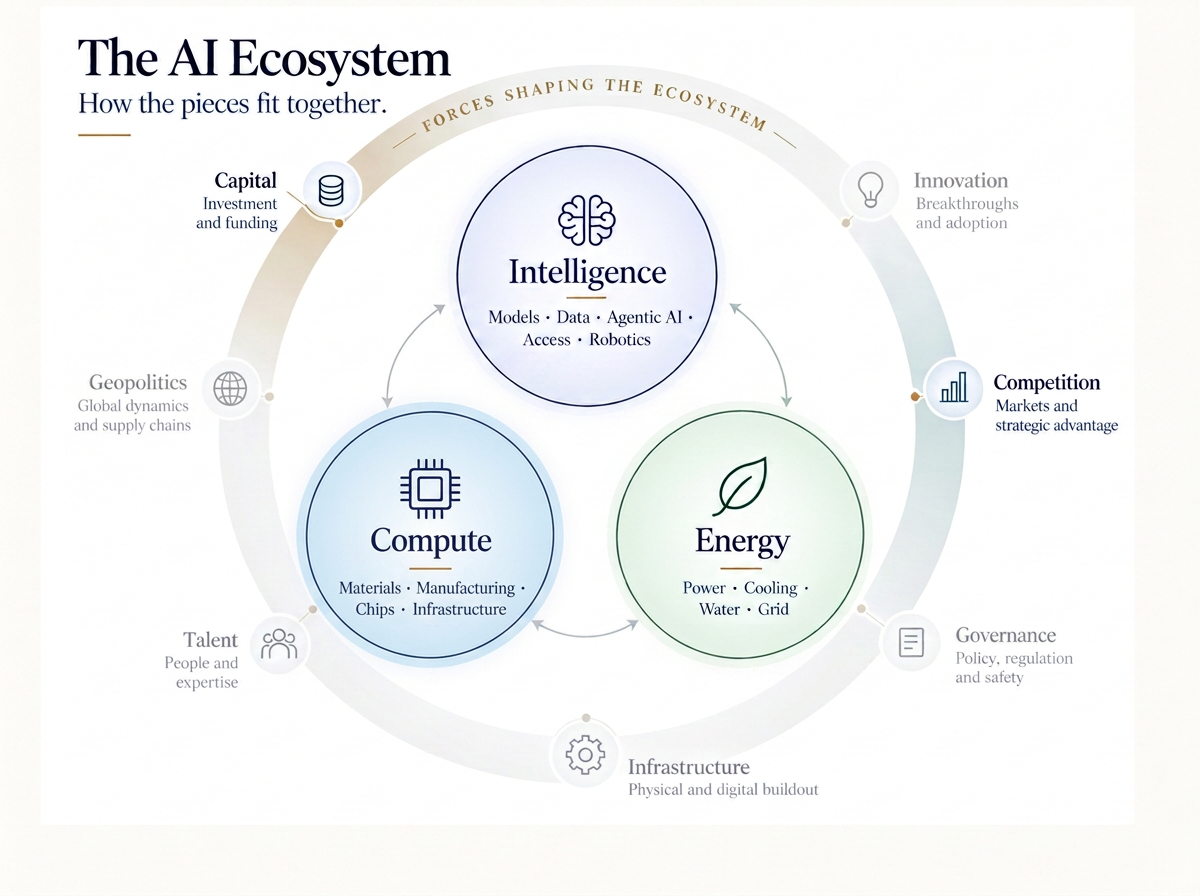
Artificial intelligence has attracted extraordinary attention.
Capital is flowing into models, chips, data centers, energy infrastructure, software and companies positioned across the AI Ecosystem.
Valuations have risen.
Investment has accelerated.
Expectations are high.
So the question appears increasingly often:
Are we in an AI bubble?
It is a reasonable question.
But before answering it, we should be clear about what we are measuring — and how well we understand what we are investing in.
Our purpose is not to predict a bubble.
It is to use the AI Ecosystem to understand where investment is occurring, how the pieces connect, and what conditions might matter if expectations change.
Bubbles are not unusual
Bubbles have appeared throughout economic history across housing, technology, commodities, energy and equities.
They tend to form when expectations about the future become unusually strong.
Prices rise.
Capital follows.
More participants enter.
Confidence reinforces itself.
Eventually, some assumptions may prove too optimistic.
That does not mean the underlying technology or asset has no value.
The dot-com bubble did not invalidate the internet.
Housing bubbles did not make housing unnecessary.
The more useful questions are:
Where is the excess? How large is it? How is it financed? And what remains when it ends?
AI is not one market
The phrase “AI bubble” can be misleading because AI is not a single asset class.
Investment spans:
- model developers
- software companies
- semiconductor designers and manufacturers
- servers and networking
- data centers
- utilities and energy infrastructure
- public and private companies
- debt- and equity-financed projects
Some may be overvalued.
Others may not be.
Some may generate strong returns.
Others may fail.
Treating the whole ecosystem as one market hides those differences.
Investment versus understanding
Investment enthusiasm does not always require deep understanding.
That is not unique to AI.
New technologies and rapidly appreciating assets often attract capital before most participants fully understand the underlying economics.
We have seen versions of this in technology, housing, commodities and crypto assets.
That does not mean the investment is necessarily wrong.
But it can be a useful signal.
Is capital entering the AI Ecosystem faster than understanding of how that ecosystem actually works?
Someone may believe they are investing in “AI” without distinguishing between a model developer, a semiconductor company, a data-center operator or an electricity provider.
Those businesses may all benefit from AI development.
But they have very different economics, capital requirements, competitive positions and risks.
This is one reason we find the AI Ecosystem framework useful.
Before asking whether AI is overvalued, it helps to understand:
What is being valued? Where does it sit in the ecosystem? What does it depend on? And how does it expect to capture economic value?
Are we valuing Intelligence — or the whole ecosystem?
Some of the biggest AI headlines are attached to companies at the Intelligence layer.
That is understandable.
Models are the part of the ecosystem people see most directly.
But Intelligence does not exist on its own.
It depends on Compute.
Compute depends on Energy.
And all three depend on capital, infrastructure, talent, governance and other forces around the ecosystem.
That raises an interesting valuation question:
Are investors valuing the economics of the Intelligence companies themselves — or partly assuming that control of Intelligence will allow them to capture an outsized share of value created across the wider ecosystem?
That distinction matters.
The value may ultimately be created across many layers.
The question is where the economics will be captured.
What should we measure?
Five questions seem particularly useful:
Valuation. Price. Amount of investment. Cost of investment. Return.
Valuation
A high valuation is not automatically irrational.
The question is:
What assumptions about future growth and earnings are required to justify it?
The more optimistic the assumptions, the more sensitive the valuation becomes to disappointment.
Price
Prices can move faster than fundamentals.
Rising prices attract attention.
Attention attracts capital.
Capital can support further price increases.
That does not prove a bubble.
But it is a dynamic worth watching.
Amount of investment
Capital is being deployed across models, chips, fabs, data centers, grids, generation, networking and robotics.
The key question is:
How much capital can the AI Ecosystem absorb productively?
A strategically sensible investment can still produce a poor return if too much capacity is built too quickly.
Cost of investment
How the investment is financed matters.
Retained earnings, equity, corporate debt, project finance and private credit carry different risks.
So we should ask:
What does the capital cost, and what return must the investment generate to justify it?
Return
AI may create value through higher revenue, lower costs, productivity, new products or strategic advantage.
But the relevant question is:
Does it create enough value to justify the amount and cost of capital being deployed?
Competition can drive overinvestment
AI is not only an investment opportunity.
It is also a competitive race.
Companies may invest because they believe falling behind would be strategically dangerous.
Governments may do the same.
That can produce individually rational decisions that collectively create excess capacity.
If everyone believes they cannot afford to wait, everyone may build.
Competition can therefore accelerate capital deployment even when the eventual financial return remains uncertain.
What does the boom leave behind?
This may be one of the most important tests.
Investment booms often leave behind productive infrastructure even when investors lose money.
Railway booms built railways.
Telecommunications booms built fiber.
The internet bubble accelerated digital infrastructure.
If AI investment eventually corrects, what remains?
Potentially:
- power generation
- transmission
- data centers
- fiber
- semiconductor capacity
- research capability
- engineering talent
- software
- new operating models
But not every asset will retain value equally.
Grid infrastructure may remain useful for decades.
Specialized computing hardware may become economically obsolete much faster.
One test of the durability of an investment boom is not simply whether investors make money, but what productive capacity remains if valuations fall.
The megatrend and the bubble can coexist
Artificial intelligence can be a genuine long-term megatrend while parts of the investment cycle are simultaneously overvalued, overbuilt or poorly financed.
Those ideas are not contradictory.
A technology can transform the economy and still experience speculative excess along the way.
So rather than asking only: Is AI a bubble? we think the better questions are:
Where might excess exist? How well do investors understand what they are actually buying? What assumptions support current valuations? How much capital is being deployed? What does that capital cost? What return is being generated? And what productive value remains if expectations prove wrong?
That helps separate the long-term AI megatrend from the investment cycle developing around it.
And it leads naturally to the next question:
If the investment cycle corrects, do the losses remain with investors — or can they spread through the wider financial system?
Continue the conversation
Ready Group welcomes thoughtful discussion around the ideas explored in Perspectives. For speaking engagements, panel discussions or private conversations on AI, leadership, strategy and organizational change, please get in touch.